
Gap & consistency checks
Catch the gaps before an officer does
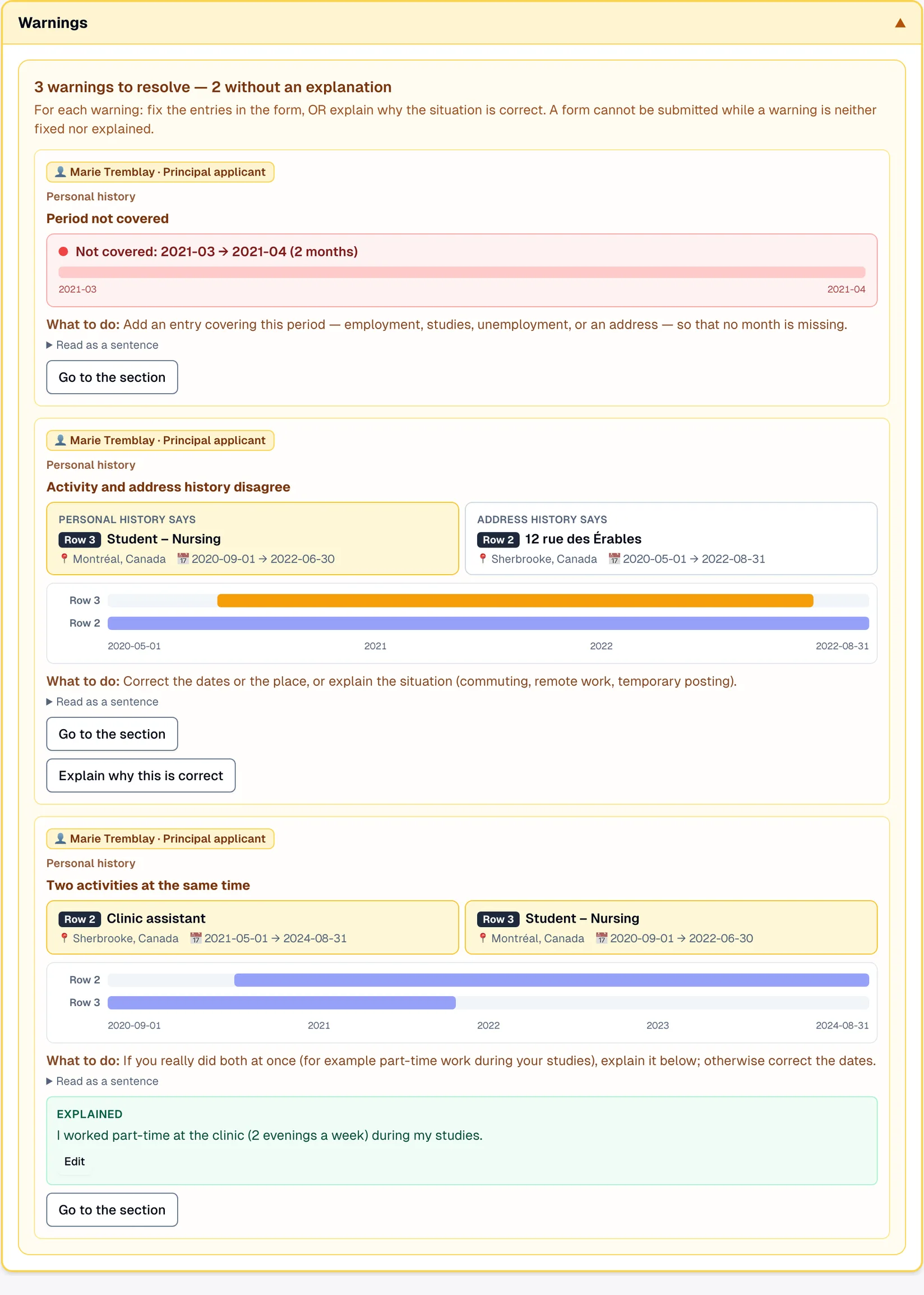
Lexova checks every personal history and address history for uncovered months, overlapping periods and locations that contradict each other — and refuses to let a form be submitted until each one is fixed or explained.
Show full screenShow less
A one-month hole in a ten-year history is the kind of thing that surfaces as a procedural fairness letter months later. Finding it by hand, across a family of applicants, is exactly the work software should do. Lexova walks each timeline month by month, inside the window IRCC actually asks about — the last ten years, or since the applicant turned 18, whichever is more recent — and stops the form from being submitted with a hole in it.
How it works
Continuous coverage, checked by month
Personal history is checked month by month: an activity ending 1 October followed by one starting 1 November is continuous, but a month nobody accounted for is flagged by name. Address history is checked to the day.
Contradictions surfaced
Overlapping activities in different cities, and addresses that disagree with where the client says they worked or studied, are raised as one clear question per entry — not a wall of duplicates.
Fix it, or explain it — before submitting
A missing period must be filled; there is no way to talk past it. A contradiction may instead be explained in the client's own words, and Lexova AI checks that the explanation actually answers the question before accepting it.
Why it matters
No silent holes
Forms cannot be submitted with an uncovered month, so the timeline you file is continuous by construction.
Explanations on file
Legitimate overlaps come with the client's own written explanation, captured while the facts are fresh — ready if IRCC ever asks.
Straight to the problem
Every warning carries a button that opens the exact section and row it refers to, for the right applicant.
Reviewed, not rubber-stamped
Filler answers are refused, and your coherence check re-tests every explanation against the uploaded documents.
Histories filed newest-first, automatically
Clients rarely enter their history in order. Personal history, address history, employment and travel tables are re-sorted most-recent-first the moment they are saved — on screen and in the generated IRCC PDF — so the officer reads the timeline the way the form expects it, and the gap check runs on the same ordered rows. Nothing is retyped and no entry is lost; only the order changes.
Frequently asked questions
What counts as a gap?+
In personal history, a calendar month that no entry touches, inside the last ten years or since the applicant's 18th birthday — whichever is more recent. Address history is stricter and checked to the day.
Can a client explain away a missing period?+
No. Gaps must be filled — even with "unemployed" or "job search", which are perfectly acceptable answers. Only contradictions are explainable.
Explore more
Run your firm on Lexova
Start today, or talk to us about Enterprise.